
7 reasons Newcastle surprised me as a wheelchair user

Newcastle had been on my travel wish list for years. I live in the Lake District, so the city is close enough for a practical break, but somehow I’d never quite managed to spend proper time there.
That finally changed during a hosted Media Getaway trip to Newcastle and the North East. Over a few packed days, I stayed in the city, met tourism boards and travel brands, ate my way around local food spots, visited cultural venues, and joined a bespoke accessible walking tour.

As a wheelchair user, I’m always looking at a destination from two angles. There’s the fun, memorable, “I can’t believe this is my job” side, and then there’s the practical reality: routes, toilets, transport, fatigue, pain, seating, timing and how easy a place feels when you’re moving through it in a wheelchair.
By the time I left Newcastle, I was tired in the way only a packed work trip can make you tired, but I was also full of ideas, new contacts and a much clearer sense of the city as an accessible break.
This guide is based on my own visit as a powerchair user. Access can change, and every disabled traveller’s needs are different, so I’d always recommend contacting venues directly before you book, especially if toilet access, parking, seating, gradients or transfer space are essential for you.
Disclaimer: My stay in Newcastle was complimentary in exchange for coverage. As always, all views are my own and based on my lived experience.
1. Hotel Gotham Newcastle brings style to an accessible stay
Accessible hotel rooms can sometimes feel like an afterthought: plain, clinical, or stripped of the atmosphere that makes a hotel feel special.
Hotel Gotham Newcastle gave me something very different.

The hotel is on Pilgrim Street, inside a Grade II listed former fire station, police station and magistrates’ court, which gives the whole place a dramatic, characterful feel. My accessible room had dark walls, bold black furniture, a large bed, a desk area, a patterned carpet and a spacious wet room.
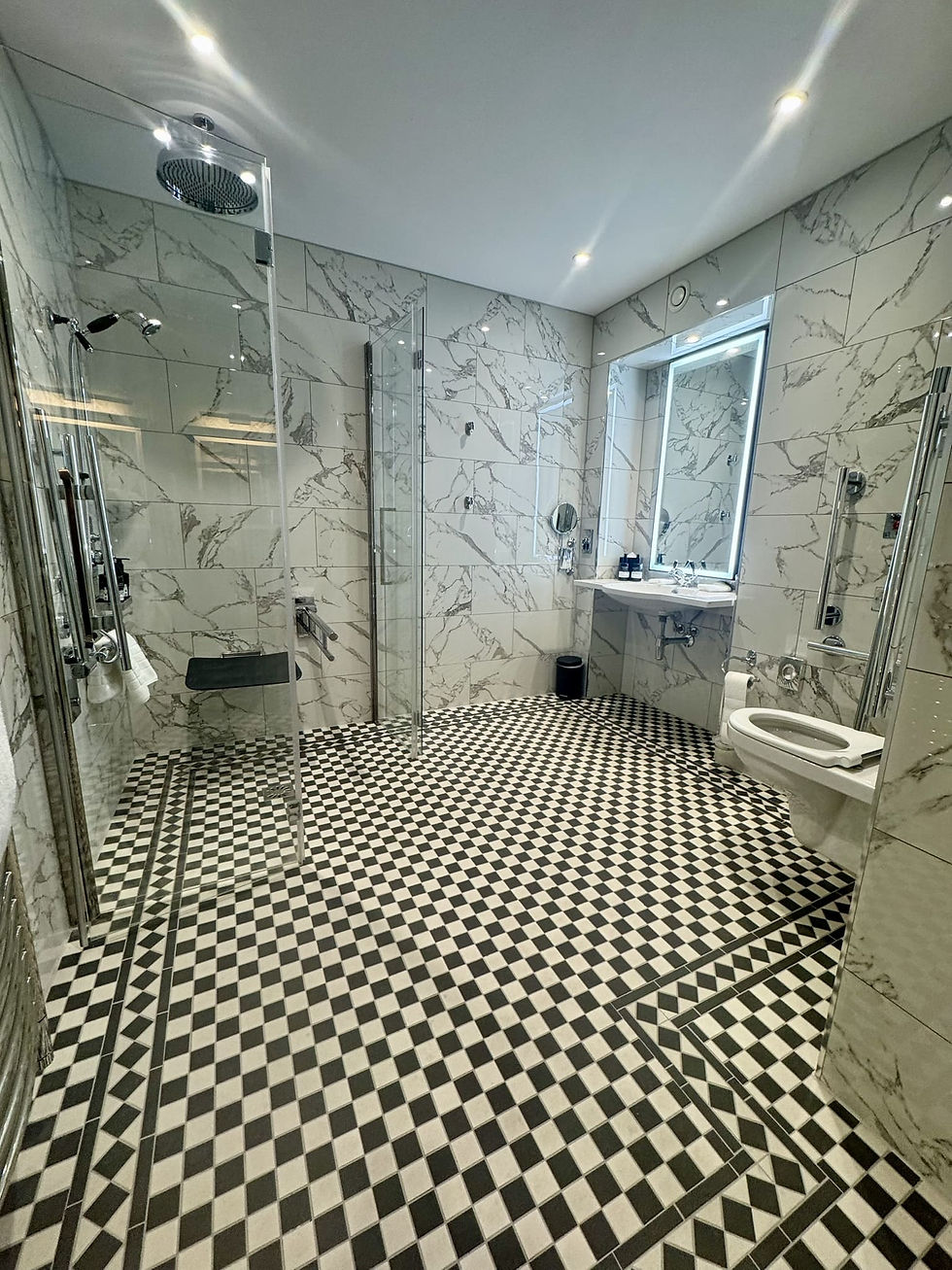
Hotel Gotham’s Club Accessible Room can be arranged as a double or twin, and it has features including an en suite marble wet room, grab rails in the bathroom, lower switches, emergency pull cords, and wider doorways. Sadly no hoist at this hotel, but there are connecting rooms for family, friends or carers.

For my powerchair, the room felt spacious enough to move around comfortably, and the bathroom was one of the strongest parts of the stay. I also ordered room service breakfast one morning before a busy day, which is one of my favourite work trip survival tactics. More sleep, less rushing, and no need to navigate a breakfast room before I’d properly woken up.
For me, Hotel Gotham Newcastle was a reminder that wheelchair accessible accommodation can still feel stylish and fun.
2. Triple A Food Tours gives you a taste of the city
Food tours are one of my favourite ways to get under the skin of a place. They give you a route, a guide, built in stops and a reason to try places you might otherwise miss.
Our tour with Triple A Food Tours started at Grainger Market and mixed Newcastle stories with independent food and drink. I tried pani puri from SnackWallah, beer from Firebrick Brewery and my first oyster from Lindsay Bros Fishmongers. A Lindisfarne oyster, to be precise.

I was very proud of myself. I was also slightly surprised by how much I liked it.
Triple A Food Tours says it’s committed to creating inclusive, welcoming and accessible experiences, and asks guests with accessibility questions to contact them before booking so specific requirements can be discussed.

Food tours can vary depending on the route, group size, timings, weather and venues included on the day. I’d ask about distance, gradients, kerbs, cobbles, seating at each stop, toilet options and whether the planned venues are step free.
What worked for me was having a guided, social way to experience the city without needing to research every stop myself. It made Newcastle feel generous, local and full of flavour.
3. Blackfriars Restaurant is atmospheric, with an important caveat
Blackfriars was one of the most atmospheric places I visited in Newcastle.
The restaurant sits in the former refectory of a friary, and that sense of history really comes through. It felt warm, old, characterful and special, making dinner feel like part of the trip rather than simply somewhere to eat.

My experience of dining there was positive. The team made wheelchair access work for me, the food was excellent, and I was glad I went.

There is an important caveat though. During my visit, the toilets were upstairs, so while the restaurant worked for me for lunch, it wouldn’t work for every wheelchair user or every visit. Blackfriars’ own access information also says some areas, including the Meeting Room, Cookery School, King Suite and Tasting Room, are on the first floor, which may limit access for some guests with mobility requirements.
That’s the reality with many historic venues. Access can be possible, but detailed questions matter. I’d ask about the entrance route, table location, internal layout and nearby toilet access before booking.
Blackfriars stays on this list because my meal there was excellent and the team made access work for me, but I’d only recommend it with that clear caveat.
4. Tyneside Cinema offers culture in a beautiful setting
Tyneside Cinema hosted our Media Getaway welcome reception, and it was a lovely introduction to Newcastle.
There’s something about an old cinema that still feels glamorous to me. The lighting, the atmosphere, the sense that going to see a film or attend an event should feel like an occasion. Tyneside Cinema had that in abundance.

The cinema’s accessibility information covers physical spaces, access screenings and accessible facilities, with a focus on creating a welcoming, comfortable and inclusive environment. Its Access Cinema programme includes parent and baby screenings, relaxed screenings, Silver Screen matinees, subtitled screenings, and hearing and vision impaired screenings.
As part of an accessible Newcastle break, Tyneside Cinema felt like a great option to know about, especially for a calmer evening between busier days.
5. St James’ Park made space for access, work and rest
I’m not a football expert, but you don’t need to be to understand how much St James’ Park means to Newcastle.

During Media Getaway, day two was hosted there for the Connection Zone, a full day of meetings between travel media and PRs. I spent the day talking to destinations and travel brands who wanted to expand media coverage of accessible travel, which felt genuinely hopeful.
The venue also gave me one of my most memorable access moments of the trip.
A couple of hours into the day, my back pain started building. I asked whether there was somewhere private where I could do my physio stretches and decompress for a while. St James’ Park pulled it out of the bag with an executive box, which is officially the fanciest room I’ve ever laid on the floor of. Years ago, I would have pushed through. Now I know that asking for what I need is part of how I stay in the room.

For visitors, Newcastle United offers stadium tours with accessible options and private tours available for larger groups, and asks people to contact the team for bespoke experiences. The stadium tours page also notes that the route can change during pitch works, which is a useful reminder to check what will be available on the day you visit.
For me, the important thing at St James’ Park was that when I explained what I needed, people listened and found a solution.
6. Kynren is a brilliant North East add on
Kynren was one of the biggest surprises of the trip.
It’s in Bishop Auckland, County Durham, so this takes you beyond Newcastle itself. But if you’re using the city as a base for a longer North East break, I’d absolutely consider adding it to the itinerary.
We visited for a preview of The Lost Feather show, the Time Travellers’ Feast and a look around the site. The feast was theatrical, generous and very funny, with characters moving through the room and storytelling woven into the meal. Kynren describes it as an immersive dining experience with live storytelling and three courses inspired by different historical eras.

I also met Vikings, who greeted me by describing my wheelchair as “a funny looking horse” and then asked me to do an angry face for photos. Honestly, iconic.
From an access point of view, this is a day out I’d plan carefully. Kynren's access information says its footpaths are flat, with a fine stone surface and lighting for evening performances, but also notes that some areas include grass or stone surfaces where wheelchair users may require assistance. The site also includes a 400 metre walk from the Blue Badge car park to the main Welcome Hub, accessible toilets, a Changing Places toilet near The Lost Feather, Blue Badge parking that must be booked in advance, and limited wheelchair and mobility scooter hire that also needs advance booking.

For me, Kynren felt like the kind of place that could be brilliant with the right planning. Think about distances, surfaces, seating, weather, fatigue and whether you’ll need someone with you. It’s big, bold and memorable. Just don’t make it the day you decide to wing it.
7. Newcastle Tour Company helped me see the city properly
One of my favourite parts of the trip was a bespoke accessible walking tour with Silvie from Newcastle Tour Company.

A good guide changes how a city feels. Instead of moving from one landmark to another, you start to understand the layers of a place. We passed grand city streets, historic arcades, public squares and the Chinatown arch near St James’ Park, with Silvie filling in the stories I’d never have picked up on my own.

For wheelchair users, the phrase “walking tour” can come with immediate questions. How far is it? Are there hills? What about cobbles, kerbs, crossings, pace, seating and toilets?
That’s why a bespoke or adapted tour can be so valuable. Newcastle Tour Company says it can arrange accessible vehicles and alter most walking tours for wheelchair users or guests with limited mobility. Its Newcastle guided tour page also lists wheelchair and stroller accessible options.
My tour worked because the route and pace felt considered. I could focus more on Newcastle, and less on constantly scanning ahead for barriers.
For an accessible city break, I’d recommend a guided tour early in the trip. It helps you get your bearings, ask practical questions and work out which places you might want to return to later.
So, is Newcastle worth visiting as a wheelchair user?
For me, yes. Newcastle gave me food, culture, history, personality and some genuinely positive access experiences. It also gave me the usual realities of disabled travel: planning, checking, pacing, self advocacy and flexibility.
That doesn’t make the trip less successful. It makes it real.
What stood out most was willingness. People listened. People problem solved. People made space for access conversations. That matters just as much as ramps, lifts and wet rooms.
For a wheelchair accessible break in the North East, I’d happily recommend looking at Newcastle. Check the details directly, keep the itinerary realistic, and leave room for rest.
And if the trip involves a stylish hotel room, a brilliant food tour, an old cinema, a stadium, a historic restaurant, a thoughtful guide and a group of Vikings calling your wheelchair a horse, even better.
Where next?
Planning more accessible adventures? You might also find these reviews helpful for choosing where to stay, visit and explore next.


Comments