
The Royal Yacht Britannia, Edinburgh | Wheelchair Accessible Attraction Review

There is a particular kind of hesitation that comes with visiting a historic attraction as a wheelchair user.
Will the route work? Will the lifts feel manageable? Will I be able to enjoy the story, or will I spend the whole visit watching thresholds, tight turns and other people’s feet?
The Royal Yacht Britannia offers something I didn’t expect: an accessible tour full of small, human details. Not just royal grandeur, but laundry rooms, mess decks, medical quarters, uniforms, telephones, bunks, buttons, bells and a very good scone.

I visited in May 2026 as part of a paid consultancy project with The Royal Yacht Britannia, reviewing the visitor experience and inclusive marketing from my perspective as a wheelchair user. As always, all views are my own and based on my lived experience.
Arriving at Britannia
Britannia’s entrance is on the second floor of Ocean Terminal Shopping Centre. Once inside the building, the route was clear. There was a large floor sign pointing visitors towards the start of the tour, with more signage and Britannia branding nearby. No hunting around. No awkward “am I going the right way?” moment. Bliss.

The lift up to the Visitor Centre was spacious enough for our group of seven, plus staff, with reachable buttons and a mirror that made reversing easier.

Then came the welcome. Staff were genuinely lovely. Warm, enthusiastic and clearly keen for us to enjoy the visit. Not the stiff, scripted kind of helpful. The good kind. The “we’ve got you” kind.
The Visitor Centre
The Visitor Centre gives you your first proper sense of Britannia before you board.
It was bright, spacious and easy to move around in my powerchair, even though the attraction was busy. I could get close to displays, move between exhibits and pause without feeling in the way.

The exhibition uses film, photographs, written interpretation, audio, tactile details and objects. Text was clear, large enough to read comfortably, and used strong colour contrast, with white text on dark blue backgrounds.
I loved the Royal Marines band uniforms, displayed at a height that worked for me from my wheelchair. Being able to get close enough to see the fabric, rather than peer from a distance behind glass, made a difference.

Boarding the yacht
The ramp from the building onto Britannia felt safe and secure. The gradient was manageable in my powerchair, the surface didn't feel slippery, and there was plenty of space.
From there, the tour weaves through the decks, rooms and stories of a ship that was both a working vessel and a royal home.

The outside decking was smooth enough to wheel over without feeling bumpy or unstable. The ramps I used were generally well graded, and I had enough room to move around other visitors. It was a busy day, but it didn’t feel overwhelming.
Life on board
One of the joys of Britannia is how close you can get to the working parts of the ship.
On the bridge, there are controls, telephones and equipment that help you imagine the yacht in motion. Some objects are higher up, others lower, and some spaces more compact, but there was enough I could get close to and enjoy.


The audio guide was clear and easy to use, with good sized buttons and clear numbering along the route. I liked that there were different lanyard options, including longer ones, so visitors can choose how to carry the device. There is also a junior audio option, which makes the experience feel more family friendly.

What I enjoyed most was the contrast between the formal and the everyday.
There are grander spaces, with polished wood, elegant rooms and a real sense of royal history. Then, a few turns later, you are in mess areas, crew spaces and practical corridors.

There were bunks, lockers, dressing up items and small tactile moments that made life on board feel vivid. The laundry room had buttons to press, fabrics to touch and a subtle laundry smell. The medical quarters had a strong disinfectant smell, which instantly told you where you were.
Accessibility on the route
There were a few tighter sections. In one area, the standard entrance into the mess was too narrow for my powerchair, so I used an alternative wheelchair accessible entrance. The signage was clear, but it did mean entering against the flow of visitors. On the day I visited, that was fine. On a busier day, it could feel more awkward.

There was also one internal corridor that looked too narrow for me to navigate comfortably, so we used the outside deck route instead. That worked well, and I didn’t feel like I was missing the experience.
The engine room gives the tour another shift in atmosphere, moving into the working heart of the yacht. There was a small ramp down into this area with a bit of camber. I managed it in my powerchair, but a wider chair or a less confident wheelchair user might find it more difficult.

Britannia has lifts that make the different decks accessible, which is impressive given the nature of the ship. The original on board lift used to access the Royal Deck Tearoom is compact and has a manual door, with staff available to help. There was enough room for my powerchair, but not for anyone else to travel with me.
Some of the other lift doors closed quite quickly, which made entering and exiting feel a little more pressured. It wasn't a major issue, but those small details shape how relaxed an access experience feels.
The Royal Deck Tearoom
The Royal Deck Tearoom was a highlight.
By this point, I was ready to sit, pause and take it all in. A chair had already been removed from the table before I arrived, which is such a small thing, but it makes a big difference. It says: we were expecting you.

The table height was good, although getting fully underneath was slightly tricky because of my powerchair joystick. The food was excellent. I had a beautiful cheese scone and a pot of jasmine tea, and our whole group enjoyed the experience.

For wheelchair users, it is worth noting that the Tearoom is accessed via the original on board lift and is only suitable for wheelchairs up to a certain width. Check the access information before visiting, especially if you use a wider powerchair.
Toilets, shop and VR
I saw accessible toilets on multiple levels, with thoughtful details that are too often missing. Full length mirrors. Hooks. Shelves. Grab rails. Multiple bins. Red emergency cords hanging freely to the floor. One toilet even had a porthole that opened, which was an unexpected joy.

There were a few things to note. In the Visitor Centre accessible toilet, the sink had limited clearance underneath for my wheelchair. On the Tearoom level, the concertina door was a little stiff. On the engine room level, the accessible toilet floor had a noticeable slope.
The gift shop was easy to browse in my powerchair, with wide aisles, good space between displays and products placed at a mix of heights. I didn’t feel like I had to ask someone else to browse for me, which is always the dream.

The main thing I couldn't access was the VR experience. The space was too narrow for my powerchair, and I suspect some manual wheelchair users would struggle too. Members of my group tried it and enjoyed aspects of the imagery, but also said the space felt very small.
Final thoughts
The Royal Yacht Britannia is one of those attractions where I could easily have spent the day braced for barriers. Instead, I found myself enjoying the details.
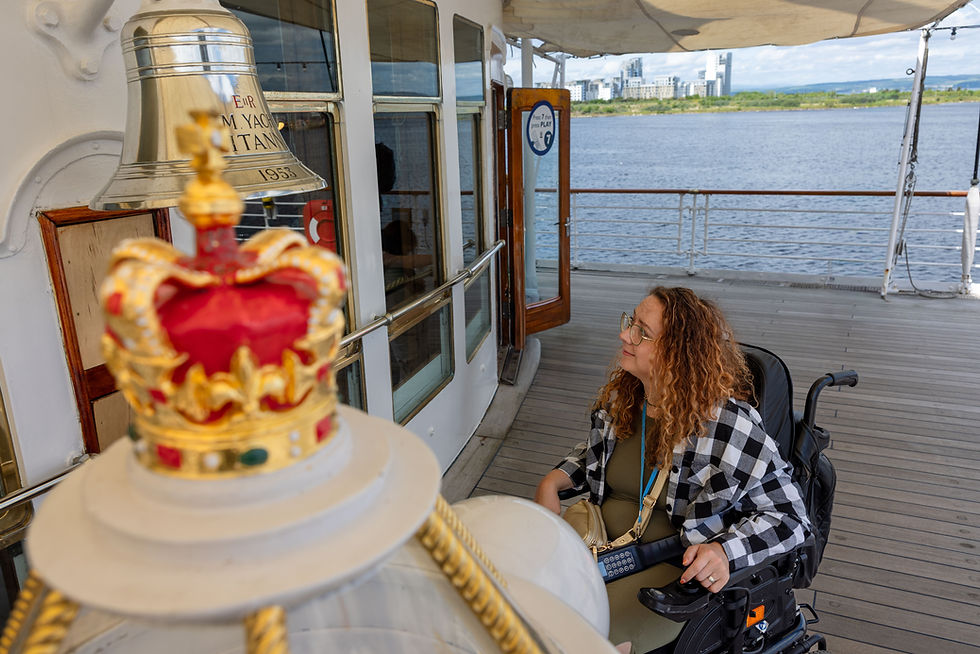
The sound of the audio guide. The shine of the bell. The view from the deck. The uniforms. The bridge controls. The laundry room. The medical quarters. The bunks and crew spaces. The scone in the Tearoom. The small thrill of moving through a historic ship in a powerchair and not feeling like an afterthought.
That doesn't mean everything was perfect. Accessibility rarely is. There were tight spaces, compact lifts, a VR experience I couldn’t use, and a few small details that could be smoother.
But overall, Britannia offers a thoughtful, enjoyable and surprisingly relaxed wheelchair accessible visitor experience.

Where next?
Planning more accessible adventures in Scotland? You might also find these reviews helpful for choosing where to stay, visit and explore next.


Comments